In India’s booming gig economy, young professionals are turning skills into extra income. From freelancing on Upwork to online tutoring, side hustles can add ₹10k–₹50k monthly—building financial freedom without quitting your job.

Building wealth, one mindset shift at a time.
In India’s booming gig economy, young professionals are turning skills into extra income. From freelancing on Upwork to online tutoring, side hustles can add ₹10k–₹50k monthly—building financial freedom without quitting your job.
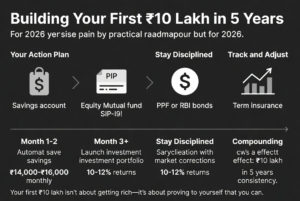
To reach ₹10 lakh in 5 years, you need to consistently save and invest ₹14,000–₹16,000 monthly at 10–12% annual returns. The real wealth acceleration happens in years 3–5 when compounding kicks in. That ₹10 lakh can become ₹25+ lakh by year 10 if you stay invested.
Your first ₹10 lakh isn’t about getting rich—it’s about proving to yourself that you can. From there, everything accelerates.

Achieve early retirement in India with this detailed FIRE roadmap. Learn to save smartly, invest wisely, and create a financially independent future.
By embracing a simpler and more frugal lifestyle, you can free up more resources to save and invest, ultimately helping you build wealth over time. Investing and saving more is the key to build wealth through minimalism. It can also lead to a more fulfilling and meaningful life
Are you struggling to build wealth despite your best efforts? The truth is, a positive and proactive mindset is essential for achieving financial success. By developing a growth mindset, creating a wealth-creating vision, managing and controlling emotions and having self-discipline you can set yourself up for long-term financial success. In this article, we explore the role of mindset in building wealth and provide practical examples and strategies for achieving financial success.
Retirement planning may not be at the top of most millennials’ minds, but it’s never too early to start building your retirement corpus. With longer life expectancy and the possibility of living without active income for longer periods of time, it’s more important than ever for millennials in India to take steps towards a secure financial future.
Are you trying to decide between an equal-weighted index fund and a market cap-weighted index fund? It’s an important decision that can have a significant impact on your investment portfolio. In this article, we’ll compare the performance of the two types of index funds using the NIFTY 50 index as an example, and help you determine which is right for you based on your financial goals and risk tolerance.
Are you a middle-income family or individual in India looking to take control of your finances and achieve your financial goals? Creating a budget is a powerful tool that can help you do just that. In this article, we’ll provide a step-by-step guide on how to create a budget that works for you, including gathering your financial information, tracking your expenses, setting financial goals, making a budget, and monitoring and adjusting your budget. Don’t miss out on the opportunity to improve your financial well-being – read on to learn more!
Are you looking to make better financial decisions and achieve your financial goals? Thinking about money in first principles can be a powerful way to do so. In this article, we’ll explore 5 ways to think about money using first principles, including understanding your values, understanding your financial situation, making a plan, taking control of your spending, and investing in your future. Don’t miss out on the opportunity to master your finances – read on to learn more!
Are you looking to improve your investing skills? Charlie Munger, a well-known investor and business philosopher, has developed a set of mental models that can help investors make more informed and effective decisions. In this article, we explore several of Munger’s mental models and how they can be applied to investing. From considering multiple perspectives and building a diverse set of mental models, to understanding the paradox of value and avoiding cognitive biases, these mental models can provide valuable insights for investors.